
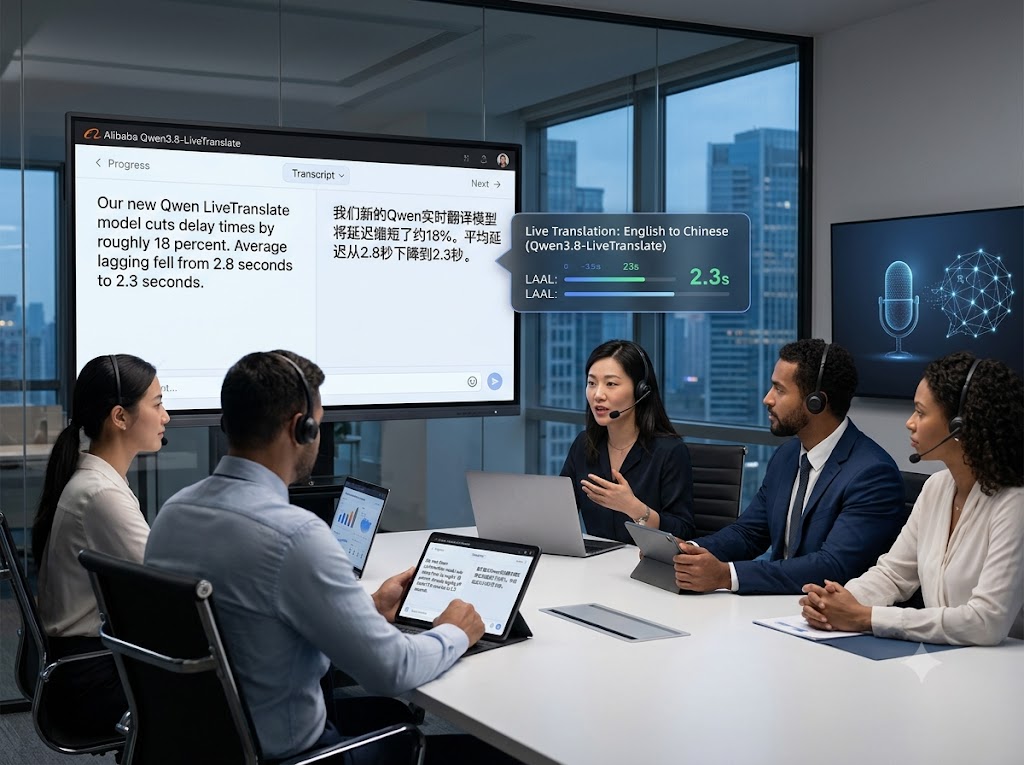
The Alibaba Qwen team released Qwen3.8-LiveTranslate as a major speech tool. The system offers live language interpretation during active talks. It listens to speech and delivers spoken and written output right away. At its core, the new Qwen LiveTranslate model cuts delay times by roughly 18 percent. The team reports average lagging fell from 2.8 seconds to 2.3 seconds. The software works across 60 languages in total. It also tracks visual cues like lip moves through video input.
Now, users can deploy the service as a hosted tool. It runs on Alibaba Cloud Model Studio and QwenCloud. Developers access the setup as qwen3.8-livetranslate-flash-realtime through a standard WebSocket feed. This step brings live translation closer to human speed.
What Is the New Qwen LiveTranslate System?
Real-time speech tasks face a hard trade-off. Waiting longer gives a computer model better context. Yet speaking too early can cause big errors. Still, waiting too long annoys listeners in live meetings. The Qwen LiveTranslate system addresses this exact gap.
First, researchers tested the setup against standard industry benchmarks. They tracked length-adaptive average lagging, or LAAL. This metric calculates how far the translation lags behind the speaker. Plus, the test prevents engines from padding words to fake low lag. Under these tests, lag dropped to just 2.3 seconds.
Then, the team compared output quality against earlier builds. The engine scored higher in accuracy, fluency, and brevity. In turn, users hear direct responses without unnecessary filler words. The design lets people hold natural talks across language barriers.
So, why does low lag matter so much? Normal human conversations move at a brisk pace. Long pauses break the flow of ideas. By then, listeners lose interest or interrupt the speaker. Thus, cutting half a second creates a much smoother meeting.
How Does the Interleave Engine Drive Qwen LiveTranslate?
The team rebuilt the processing pipeline from scratch. Instead of running separate steps, the tool relies on an Interleave architecture. This design blends audio ingestion with instant phrase output.
Next, the team connected the setup to the Qwen-Omni framework. This base uses massive multimodal training data. It also applies cross-language and cross-modal alignment methods. As a result, the model links spoken words directly to meaning without extra steps.
And the underlying model handles offline media just as well. The non-realtime Flash edition translates stored audio and video files. But the live WebSocket variant targets active speech sessions. In short, the architecture makes the Qwen LiveTranslate engine flexible across varied use cases.
Once raw audio enters the buffer, decoding starts instantly. The model decides when to output words on the fly. Rather than waiting for full sentences, it processes semantic chunks. Even so, the model preserves grammar in the target tongue.
While older tools waited for long pauses, this system adapts continuously. It predicts sentence endings based on conversational patterns. This move saves vital split seconds in heated debates.
Key Features in the Qwen LiveTranslate Rollout
The update introduces three major functional gains for production teams. First, it features real-time speaker diarization. The engine separates different voices in crowded rooms.
Also, it preserves voice identity through fast voice cloning. The API includes several cloning controls for app creators. For instance, the always mode clones the speaker before each response. This keeps distinct voices recognizable in busy panel chats.
Next, the tool adds a synchronized bilingual display. The screen shows the original speech right beside the translated text. In the API feed, the source transcript streams alongside the new translation events.
Plus, the platform introduces long-context disambiguation. The system remembers past discussion points to resolve tricky names. If someone shares a name early on, the model keeps it consistent later. This solves a major flaw found in basic translation engines.
Now, teams can deploy the Qwen LiveTranslate service for complex enterprise talks. Board meetings often rely on unique industry jargon. The memory cache ensures terms stay accurate throughout the hour.
How Does Qwen LiveTranslate Process Vision and Speech?
The model demonstrates broad linguistic range. It understands 60 languages from global regions. Out of those, it can speak 29 languages with generated audio and text. The remaining 31 languages return translated text only.
Speech synthesis covers major tongues like Chinese, English, Arabic, German, and French. It also speaks Spanish, Japanese, Korean, and Hindi. This wide range covers the majority of global business talks.
Now, visual input gives the model an extra edge. The system accepts video frames alongside raw audio. Visual cues like lip movements help in loud conference halls. They also help clarify homophones and muffled phrases. Official technical details advise sending no more than two video frames per second.
Still, companies often use rare product labels. The platform lets teams supply custom hotwords. These hotwords force exact translations for brand names. Engineers can register up to 1,000 hotwords per live session.
In turn, the visual stream and hotword list work in tandem. The model spots confusing terms and cross-checks the text guide. This dual approach keeps error rates low during critical product reveals. By using Qwen LiveTranslate with camera feeds, remote workers enjoy clear cross-border collaboration.
Developer Costs and Limits for Qwen LiveTranslate
Engineers connect to the service using WebSocket connections. The official model identifier is qwen3.8-livetranslate-flash-realtime. The standard turn detection mode uses speaker_detection.
Clients stream continuous audio and receive server-generated packets. The engine expects 16 kHz PCM audio input. It then returns 24 kHz PCM audio output. Tina serves as the default voice persona.
Builders set the session.output_modalities field to text, or text plus audio. They must send a session.finish command before closing sockets. Without that signal, the server drops the final spoken phrase.
List rates vary by cloud data center location. In Singapore, pricing per one million tokens follows these tiers:
- Audio input costs $7.50
- Image input costs $0.55
- Text output costs $20.00
- Audio output costs $30.00
Beijing pricing offers lower rates for regional traffic:
- Audio input runs at $5.653
- Image input runs at $0.466
- Text output runs at $14.133
- Audio output runs at $22.613
Audio input consumes 7 tokens per second. In contrast, audio output uses 12.5 tokens per second. One hour of speech in and out costs about $1.54 in Singapore before text charges.
The context window supports 53,248 tokens in total. That includes 49,152 tokens for input and 4,096 tokens for output. Default rate limits allow 10 requests and 100,000 tokens per minute. Model Studio does not support function calls, batch runs, or fine-tuning.
Yet these clear caps help teams budget expenses early. Running Qwen LiveTranslate in production remains affordable for most corporate setups. The steady billing model encourages wider adoption across web apps.
What Lies Ahead for Real-Time Translation Models?
Real-time interpretation tech is advancing at a rapid rate. Alibaba's launch shows how multimodal context solves old translation errors. Adding video to audio feeds marks a strong step forward.
Soon, rivals will push lag times below the two-second mark. Instant speech interpretation will become standard in teleconference software. People across continents will converse without awkward delays.
That said, closed-weight hosted APIs limit local deployments. Edge devices cannot yet run these massive networks locally. For now, developers must rely on steady cloud connections.
Still, enterprise interest in live interpretation keeps climbing. Global firms want frictionless talks without hiring large translation pools. The Qwen LiveTranslate rollout gives builders a solid path toward that goal.
As speech tools grow more capable, Onegen coverage continues to track the latest steps in multimodal AI.