
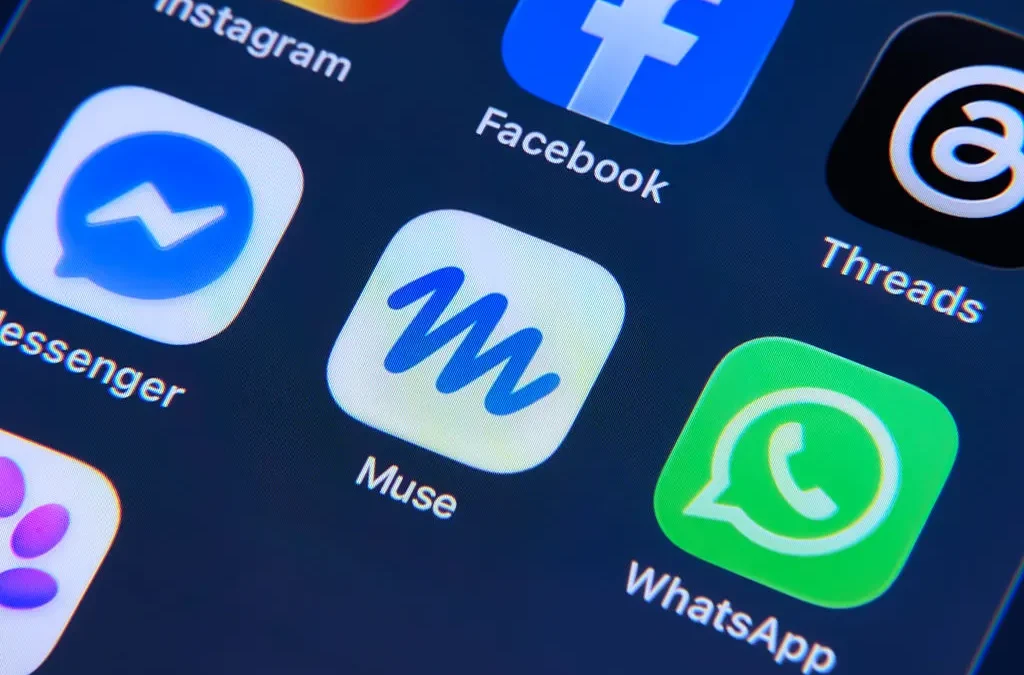
The Meta Muse app has officially outpaced ChatGPT in early mobile app adoption. Fresh figures reveal that the new AI tool attracted more downloads and daily users in its first 12 days than OpenAI saw during its mobile debut. Market intelligence data demonstrates that Meta now holds an early lead in the consumer AI race.
Now, mobile users are flocking to new AI tools at a record pace. The Meta Muse app launched recently as a dedicated personal AI agent. So far, the rollout covers the United States and Canada. Despite this regional limit, user demand has quickly surged past early industry benchmarks.
First, analysts noticed rapid movement up the app charts. Then, mobile data confirmed the scale of this launch. In its first 12 days, the Meta Muse app secured 2.8 million total downloads worldwide across iOS and Android. That rapid pace placed the software at the very front of the mobile AI market.
How Does the Meta Muse App Surpass ChatGPT?
Direct comparisons between top AI apps are often tricky. After all, tech firms do not always follow the same rollout plan. When OpenAI launched ChatGPT on mobile, it picked a global path. But that release was limited strictly to Apple devices on iOS.
By contrast, the Meta Muse app took a different route. Meta chose to launch across both the Apple App Store and the Google Play Store. Yet the social media giant restricted early access strictly to users in the United States and Canada.
To create a fair comparison, analytics firm Apptopia isolated the numbers. The research group looked only at iOS data within the United States and Canada. The study examined the first 12 days of availability for each tool.
Even on this narrow playing field, the Meta Muse app took the lead. On iOS in North America, the Meta Muse app captured 1.8 million downloads in its first 12 days. During the same window after its release, ChatGPT recorded 1.3 million downloads on iOS in those same two countries.
Plus, the momentum did not stop at installs. The Meta Muse app also claimed a higher share of active daily visitors. Data shows that users are not just trying the tool once and leaving. Instead, they are coming back each day to chat and build new habits.
Download Records for the Meta Muse App
Rankings inside digital storefronts quickly reflected this swift user growth. Right after its debut, the app took the No. 2 spot on the United States iOS App Store. Soon after, it climbed even higher.
As reported by market research firm Appfigures, the Meta Muse app officially crossed 1 million installs and captured the No. 1 overall rank in the United States. That surge placed Meta directly ahead of ChatGPT on top store leaderboards. Reaching the top rank confirmed broad consumer appeal beyond core tech enthusiasts.

Still, raw installs tell only half the story. Sustained software success needs steady daily engagement. Here, the Meta Muse app demonstrated even stronger performance against historical launch numbers.
In the United States alone, the Meta Muse app reached 642,000 daily active users during its initial 12-day span. By comparison, ChatGPT posted 231,000 daily active users over its first 12 days on the market. That gives Meta nearly three times the daily active user base of its primary rival during the same launch stage.
Mobile Growth on iOS and Android
Some critics noted that Meta benefits from supporting two operating systems at once. Because the Meta Muse app runs on both Android and Apple hardware, its total reach starts wider. That gave the tool an early structural edge over single-platform launches.
Even so, filtering the daily active user data by platform still favors Meta. Apptopia narrowed the comparison strictly to iOS devices in the United States. In that breakdown, the Meta Muse app maintained 359,000 daily active users.
That total remains well above the 231,000 daily active users that ChatGPT posted on iOS in the same launch frame. Thus, Meta outperformed OpenAI even when analysts removed all Android users from the equation. The numbers confirm clear consumer interest in Meta’s new software design.
While these figures rely on third-party estimates rather than Meta’s private servers, industry analysts view them as reliable indicators. They provide a clear view of real user behavior in competitive mobile app markets.
What Powers the Meta Muse App Engagement?
Meta holds a massive structural advantage that startup labs cannot match. That weapon is its vast global family of apps. With billions of daily visitors, Meta can promote new products at zero extra marketing cost.
First, look at the playbook used for Threads. Meta built that social platform into a network of over 500 million monthly users. It achieved that milestone by displaying real-time updates directly inside Instagram feeds and Facebook timelines.
Now, the Meta Muse app enjoys that same corporate engine. The AI software connects directly with Meta accounts. It also links into WhatsApp, giving it immediate access to the world’s most popular messaging network.
App data illustrates this tight ecosystem bond. Over 95% of people using the Meta Muse app are active Facebook users. As well, 63% of its audience regularly uses Instagram.
These high overlap percentages show that Meta is successfully moving its existing community into AI tools. Rather than hunting for new customers, Meta simply points its active community toward the new app. In short, distribution power remains the company’s biggest growth lever.
Network Integration and Social Graph Reach
Deep social integration drives high retention numbers. A standalone AI agent must work hard to remain top of mind. But an assistant connected to your primary social circles stays visible every single day.
Once a user connects an AI assistant to daily chat threads, the app becomes indispensable. It can summarize conversations, schedule group events, and generate custom media on demand. That deep utility turns casual downloads into dedicated daily active users.
Yet this level of system access also raises valid questions about user data. An AI agent tied to personal social graphs can read private interactions and personal interests. For now, users seem eager to trade access for everyday convenience.
Even so, privacy advocates urge caution when linking AI agents to personal networks. As Meta integrates the assistant deeper into daily communications, regulatory scrutiny will surely follow. Data governance will remain a central debate throughout the product lifecycle.
The Competitive Road Ahead for the Meta Muse App
Early success provides momentum, but keeping users engaged is the real test. Many viral apps experience a fast initial surge before activity fades away. The Meta Muse app must prove it can retain users over several months.
Meanwhile, OpenAI continues to roll out major updates to ChatGPT. Rivals are adding voice mode enhancements, faster reasoning tools, and deeper agent workflows. The market for consumer AI tools is moving faster than ever.
Meta has not yet published its own internal metrics for the rollout. The company chose not to comment on the new third-party estimates. But the early market response shows that consumer AI is no longer a one-horse race.
Soon, Meta plans to expand the app beyond the United States and Canada. Launching across Europe, Asia, and Latin America could drive millions of additional installs. If international markets show similar enthusiasm, adoption curves could break new records.
In turn, rivals will need to rethink their consumer distribution plans. Great AI models need strong consumer reach to win mass adoption. As the competition heats up, more AI coverage continues to monitor the top tools reshaping the industry.