
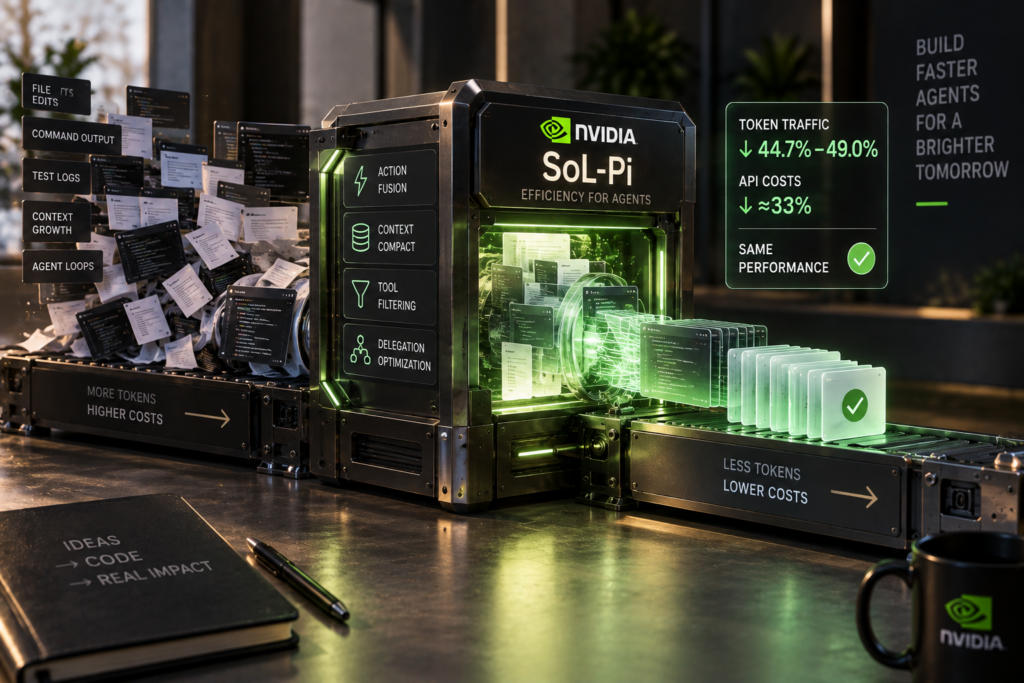
Autonomous coding agents now handle complex software engineering tasks for hours at a time. Each file edit, command execution, and test log flows directly back into model memory. As context expands, token traffic surges and costs escalate quickly. To solve this problem, researchers from NVIDIA, NTU, and MIT built NVIDIA SoL-Pi as an efficiency extension for the open-source Pi coding agent. The system introduces four novel mechanisms that reduce recorded token traffic by 44.7% to 49.0% while trimming API expenses by roughly 33%. Remarkably, the agent achieves these reductions while maintaining performance parity across rigorous benchmarks.
What Makes NVIDIA SoL-Pi a Breakthrough for Coding Agents?
Traditional efficiency methods focus on lowering the price of individual tokens. Engineers often rely on model quantization, custom kernels, or smaller architectures to cut expenses. Yet NVIDIA SoL-Pi adopts a different philosophy by minimizing the total token volume a task requires. It targets the agent harness layer directly. The harness coordinates tool execution, manages prompt context, parses environment outputs, and handles sub-agent delegation.
Tuning an agent harness manually presents serious engineering challenges. Different components remain tightly coupled, meaning an optimization in one area often creates bloat downstream. Previous automated approaches like Meta-Harness attempted to evolve these systems systematically. But recent research revealed that evolved harnesses frequently overfit their training suites, offering weak gains on unseen real-world tasks.
NVIDIA SoL-Pi overcomes these limitations by applying structured auto-research loops to identify robust mechanisms. The system ships publicly on GitHub under NVlabs as an open-source, MIT-licensed package. Developers can install it cleanly on unmodified Pi 0.85.1 releases using Node.js 22.19 or newer. By improving how the harness structures interactions, developers preserve model intelligence while preventing context saturation.
How Does NVIDIA SoL-Pi Search for Efficiency?
To find optimal modifications, an autonomous research model evaluates execution traces from an agent running base Pi. The optimizer proposes precise adjustments to the harness code and benchmarks them inside isolated environments. In total, the discovery process examined 152 distinct directions across six functional domains. These families encompassed context handling, task progress, tool execution, delegation patterns, prompt policy, and evaluation rules.
The search evaluated candidates across 535 executable environments. First, researchers constructed 495 environments from real GitHub issue and pull request pairs. Then, they added 40 synthetic challenges equipped with deterministic verifiers. Across more than 3,000 runs, the research agents logged over 60,000 live environment interactions. Each iteration followed an automated research cycle augmented by a Ralph Loop implementation step alongside an independent evaluation agent.
Rigid constraints prevented the search system from cheating or degrading core reasoning. Acceptance metrics remained locked before exploration started, and candidate updates could not alter them. Every viable candidate had to preserve functional accuracy within strict tolerances while proving measurable gains on at least one efficiency metric. Crucially, the EdgeBench benchmark remained held out. The team designated 11 tasks for single-pass candidate validation and reserved 40 tasks strictly for final scoring, ensuring NVIDIA SoL-Pi never overfitted to the evaluation data.
The Four Core Mechanisms Inside NVIDIA SoL-Pi
Out of 152 proposed configurations, exactly four durable mechanisms survived the rigorous validation battery. Each mechanism resolves a specific architectural inefficiency in how coding agents manipulate context during long tasks.
- Action Fusion: Base Pi frequently alternates between separate tool calls, editing a script first and then issuing a standalone command to run tests. Action Fusion combines these interdependent operations into a single structured tool request. By merging execution and observation, the harness removes an entire network round trip.
- Online Context Compact: During multi-step projects, progress tracking runs through an
update_planmodule. When a subtask concludes, the harness calculates the expected token savings against the cost of invalidating the prompt cache. It initiates native compaction when the projected savings clear this threshold or when context space runs out. - ObservationPack: Large tool responses can flood context windows with noisy syntax. Under this policy, command outputs larger than 10 KiB are archived on local disk while full text passes to the model for two consecutive turns. By the third turn, the harness replaces raw logs with a compact handle, file sizes, and brief excerpts. The agent retains full access to retrieve exact pages whenever needed.
- Evidence-Preserving Reducer: Extended build outputs and terminal logs exceeding 4 KiB pass to a secondary model, GPT-5.6 Luna at high settings, to generate compact summaries. A deterministic verifier validates output schema, source hashes, exit codes, and exact citations. If validation fails or security checks flag credentials, the harness falls back to raw logs.
Through these four techniques, NVIDIA SoL-Pi curtails repetitive data transfers without blinding the primary agent during complex debugging sequences.
Benchmark Performance and Cost Savings
Researchers tested the combined package thoroughly on the 51-task EdgeBench evaluation suite. Evaluators measured overall token consumption, total dollar cost, and average completion accuracy against industry-standard baselines. The study benchmarked leading frontier models, comparing native harnesses against Pi and the optimized NVIDIA SoL-Pi stack.
On GPT-5.6 Sol, the native Codex harness consumed 3.05 billion tokens at an API cost of $1,787, scoring 34.7 points. Base Pi improved accuracy to 44.8 points while consuming 2.15 billion tokens at $1,339. Applying the efficiency profile of NVIDIA SoL-Pi dropped token consumption to just 1.10 billion tokens and cut spending to $894, while retaining a strong 42.0 score. Alternatively, configuring the system for performance yielded an impressive 47.2 score with 2.02 billion tokens at $1,271.
Similar improvements emerged when testing Anthropic's Opus 5 backend. The native Claude Code harness consumed 2.00 billion tokens at $2,535, achieving a 43.7 score. In comparison, base Pi scored 44.8 points across 2.37 billion tokens at $1,741. Running the efficiency configuration of NVIDIA SoL-Pi reduced token volume to 1.31 billion and lowered expenses to $1,158, preserving a 42.2 average score. Setting the system for maximum capability reached a chart-topping 50.5 score using 2.10 billion tokens at $1,605.
Importantly, the entire mechanism stack was discovered on GPT-5.6 Sol trajectories and transferred directly to Opus 5 without retraining. On Opus 5, the agent retains 94.3% of base Pi performance while slashing tokens by 44.7% and costs by 33.5%. On GPT-5.6 Sol, it sustains 93.7% of base capability while cutting tokens by 49.0% and expenses by 33.2%. While cache-write volume rose slightly from 0.0141 billion to 0.0316 billion tokens, net billing fell sharply.
Real-World Validation Across Complex Tasks
To confirm robustness, the research group evaluated the system beyond standard benchmarks. They deployed the harness across diverse challenges, including terminal interactions, formal mathematical reasoning, and collaborative multi-agent swarms.
On Terminal-Bench 4, which features 63 demanding CPU execution tasks, NVIDIA SoL-Pi resolved 15 challenges compared to 18 solved by both Codex and base Pi. Still, the framework reduced total operating costs by 26.3%, dropping expenses from $286.45 down to $211.12. In formal mathematical verification, researchers tested candidate agents against six problems from the IMO 2026 competition using Lean 4. The framework matched base Pi by passing 3 of 6 challenges while establishing the lowest cost per solved proof at $20.90.
Researchers also examined resource scaling inside an agent swarm. The architecture featured a Codex coordinator overseeing 20 parallel worker instances. With standard Pi workers, the swarm executed 1,366 cycles at a cost of $82.12. Replacing them with NVIDIA SoL-Pi workers achieved 1,127 cycles for only $60.11. Although a single Codex coordinator operating solo remained cheaper at $39.20 across 1,333 cycles, the experiment demonstrated clear cost control across parallel fleets.
The authors observed that cross-model transfers remain preliminary. Mechanisms like Action Fusion fired less frequently on Opus 5 than on GPT-5.6 Sol. Because the automated search mined execution traces exclusively from GPT-5.6 Sol, certain heuristic triggers aligned more closely with that model's behavioral tendencies.
The Future of NVIDIA SoL-Pi in Production
Agent harnesses represent an essential layer in modern software automation. As frontier models take on multi-hour programming tasks, unmanaged tool traces inevitably inflate hosting bills and crowd context buffers. By providing an open-source, automated remedy, the research team shows that systems engineering can yield efficiency gains comparable to model-level optimizations.
Developers can review the complete methodology in the team's formal research paper and access the code via the NVlabs GitHub repository. Because the framework functions as an opt-in extension, teams can integrate it immediately without disrupting existing developer workflows. As agentic programming continues its rapid evolution, comprehensive AI coverage remains critical for tracking new architectural breakthroughs across enterprise environments.