
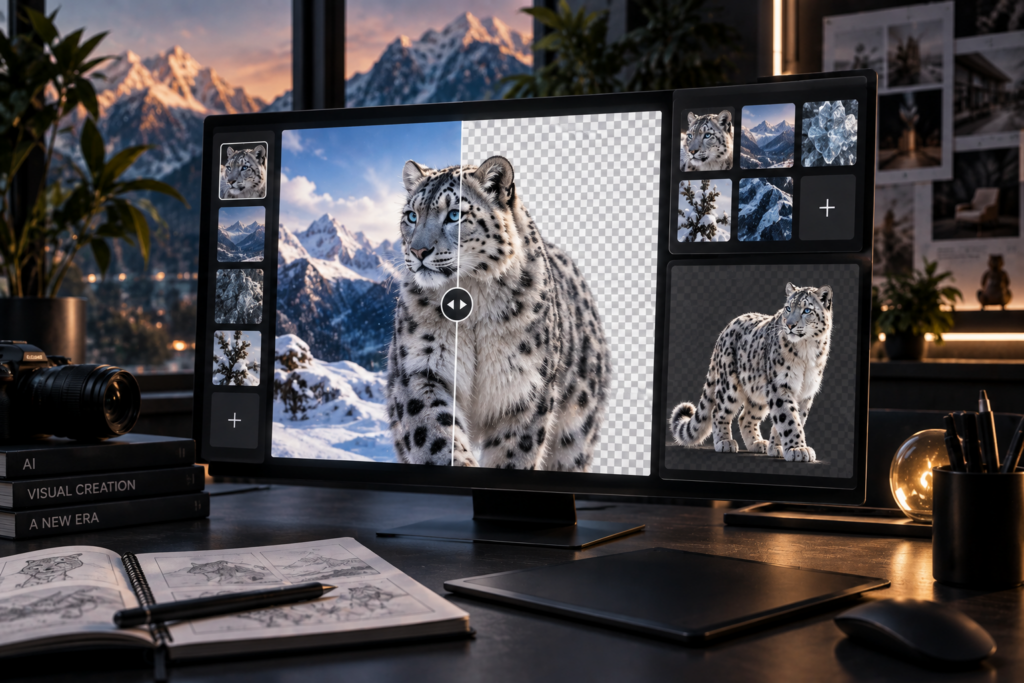
Alibaba has officially unveiled Qwen-Image-2.1, a unified vision model that pairs text-to-image generation with image editing. The release marks a major architectural update for the open-weight AI space. In the past, teams had to maintain two separate systems to handle visual generation and editing tasks. Now, Qwen-Image-2.1 wraps both capabilities into a streamlined seven-billion-parameter backbone.
The launch arrives via the Alibaba Qwen research team, landing as a consolidated checkpoint designed to cut serving costs. Still, the smaller footprint does not sacrifice visual precision. The model natively outputs transparent visual assets, handles regional image changes, and blends up to ten reference pictures at once. Researchers can now download the Hugging Face weights to test the weights on standard hardware.
How Does the Qwen-Image-2.1 Architecture Work?
The previous generation system shipped in August 2025 as a massive twenty-billion-parameter foundation. That model operated under an Apache 2.0 license. In that older release, image editing required a separate companion checkpoint. The new Qwen-Image-2.1 setup compresses those duties down to about one-third of the original size. The team considers this release the most balanced tool in the entire model family.
Even so, builders must evaluate total memory needs carefully before deployment. While the core diffusion transformer uses 7B parameters across 32 single-stream layers, the overall inference pipeline loads an 8B Qwen3-VL encoder as well. Thus, your hardware must accommodate both components during active generation.
The system relies on four primary building blocks:
- Diffusion Transformer: A 32-layer, 7B parameter single-stream block-causal attention module.
- Text Encoder: An 8B Qwen3-VL model that merges text prompts and visual guidance into one unified vector space.
- Variational Autoencoder (VAE): A 64-channel RGBA module offering 16x spatial compression alongside native alpha transparency.
- Flow Matching Scheduler: An Euler discrete scheduler that incorporates dynamic shifting algorithms.
Inside the Qwen-Image-2.1 Attention Pipeline
Speed gains within Qwen-Image-2.1 stem directly from an advanced attention mask design. Text tokens process through a strict token-level causal mask. In contrast, image tokens pass through a chunk-level bidirectional mask within each image frame. The engineering team calls this split technique mixed-granularity attention.
Because condition prefixes sit ahead of noisy latent tokens, they never attend to the noisy data. Their key and value representations remain unchanged across denoising passes. Therefore, Qwen-Image-2.1 evaluates input text and reference imagery only once on the first denoising step. Then, it reuses that prefix key-value cache across all following steps. In turn, compute savings scale up rapidly when processing complex, multi-image edit prompts.
What Are the Core Features of Qwen-Image-2.1?
Native transparency stands out as a major technical breakthrough for Qwen-Image-2.1. Most legacy diffusion engines produce standard RGB frames. Removing backgrounds normally demands secondary cutout utilities or matting models. But Qwen-Image-2.1 renders true RGBA files right from raw user prompts.
This built-in alpha channel lets digital artists build transparent layers with clean borders. Users can also isolate subjects directly from existing photos without extra tooling. The developers suggest using a standard prompt template when generating transparent layers to ensure clean borders.
Resolution handling also sees substantial upgrades. The system defaults to 2048 by 2048 pixel canvases. It also supports seven aspect ratios ranging up to 2752 by 1536 pixels. In short, creators can render clean 2K visual assets for infographics, wide panoramas, and high-detail character portraits.
Multi-Reference Editing and Transparent RGBA Layers
Image consistency remains a persistent hurdle in commercial generative workflows. Alibaba addresses this pain point by enabling multi-reference editing for up to ten source images. For example, technical demos show the system building a cohesive six-person group shot from six isolated portrait photos. In another test, the model assembled a complete wardrobe mockup from five separate clothing pictures.
Local editing also gains granular targeting controls. Creators can mark target regions with circular boundaries, drawn brush masks, or separate alpha channels. As well, the model keeps original facial traits and product labels intact throughout the edit pass. This reliability helps artists run virtual try-on workflows without distorting essential subject details.
Benchmarking Qwen-Image-2.1 Against Open Models
To measure overall output quality, researchers ran extensive evaluations across their standardized test suite, dubbed Qwen-Image-Bench. Within this internal benchmark, Qwen-Image-2.1 earned an overall score of 60.28 points. That mark lifts the checkpoint above every other open-weight competitor listed in the test data.
For instance, the model edges past Nano Banana 2.0, which scored 59.82 points. It also creates a wide gap over FLUX 2 Max, a 32B open competitor that achieved 55.33 points. That metric highlights how modern architectural tweaks can help a 7B engine outpace larger counterparts.
Still, closed-source commercial APIs retain the ultimate lead on this specific benchmark suite. Six proprietary cloud platforms placed above the Alibaba release. At the top of the leaderboard, GPT Image 2.5 Sunburst holds first place with an overall rating of 67.01. Even so, Qwen-Image-2.1 provides researchers with a capable local alternative that bypasses remote cloud dependencies.
Deployment Pipelines and Hardware Support
Deploying Qwen-Image-2.1 in local environments requires modern machine learning packages. Practitioners need PyTorch 2.4.0 or newer, Hugging Face transformers 5.17 or higher, and the latest Diffusers library compiled from source. The following script runs standard text-to-image synthesis:
import torch
from diffusers import QwenImage21Pipeline

pipe = QwenImage21Pipeline.from_pretrained(
    "Qwen/Qwen-Image-2.1", torch_dtype=torch.bfloat16
).to("cuda")

image = pipe(
    prompt="A neon shop sign that reads \"QWEN IMAGE 2.1\", rainy night",
    num_inference_steps=40,
).images[0]
image.save("t2i.png")
The identical pipeline processes image editing tasks when users supply reference images through the primary input call. On consumer GPUs with tight VRAM headroom, calling CPU offload methods lowers peak memory draw substantially. For community desktop users, ComfyUI includes native workflow nodes alongside converted weight packages in multiple precision formats.
Production inference systems gain day-one support across multiple specialized runtimes. Platforms like vLLM-Omni introduce FP8 quantization, prefix caching, and CUDA Graph decoding. Meanwhile, the SGLang stack introduces Cache-DiT optimizations and multi-GPU tensor parallelism. Hardware support also moves past NVIDIA silicon to include AMD Radeon accelerators via ROCm and eight diverse enterprise architectures through FlagOS. You can review the official codebase via the GitHub repository for specific hardware setup guides.
Prompt Rewriting and License Terms for Qwen-Image-2.1
Alibaba also published two companion prompt-expansion models alongside Qwen-Image-2.1. These helper tools are fine-tuned versions of Qwen3.5-VL 9B. One variant specializes in standard text-to-image prompts, while the other guides complex image editing jobs. Both models can ingest brief user phrases, expand them into expressive descriptive prompts, and pick the best canvas proportions automatically.
Licensing represents an important pivot for this release. While the earlier 20B checkpoint used a permissive Apache 2.0 license, Qwen-Image-2.1 ships under the custom Qwen Research License. This agreement allows open research, testing, and non-commercial exploration. But commercial installations require a separate commercial agreement directly from Alibaba.
Overall, the new release gives the AI community a balanced, flexible image creation system. By pairing a unified diffusion transformer with prefix caching and native alpha transparency, it sets a strong technical foundation for local image synthesis. As multimodal models continue to evolve rapidly across the tech sector, fresh industry analysis helps engineers track the shifting boundaries of open-weight systems.