
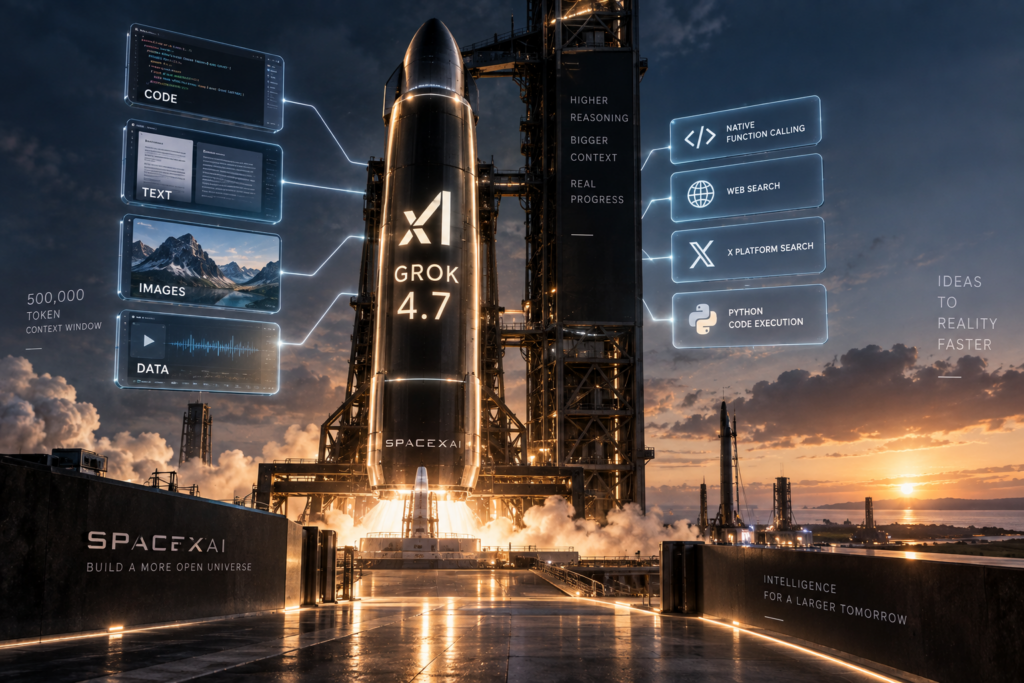
SpaceXAI has officially launched Grok 4.7, its newest flagship model for software coding, agentic workflows, and complex knowledge tasks.
Now, developers can test the system across multiple coding environments and cloud gateways. The release lands as an upgrade over Grok 4.6, yet it keeps identical pricing tiers. Users pay $2 per million input tokens and $6 per million output tokens. SpaceXAI built the system on a fresh base foundation rather than fine-tuning older weights. In turn, the release pairs expanded reasoning depth with lower latency across production workflows.
What Does Grok 4.7 Bring to Developers?
First, teams can deploy Grok 4.7 directly through hosted endpoints without waiting for waitlists. SpaceXAI made the model available on day one through the official xAI API. In addition, teams can run it inside Cursor, Grok Build, OpenRouter, Vercel, and Cloudflare.
Plus, the model accepts both text and image inputs while returning high-speed text outputs. The system processes inputs through a massive 500,000-token context window. That large window lets teams feed entire codebases, legal libraries, or multi-hour system logs into a single prompt session.
Still, the core technical specifications reveal deep architectural planning:
- Model Identifier:
grok-4.7 - Context Window: 500,000 tokens
- Knowledge Cutoff: May 2026
- Modalities: Text and image inputs; text outputs
- Reasoning Levels: Low, medium, high (default setting), and xhigh
- Supported APIs: Responses API and Chat Completions
- Built-in Tools: Native function calling, web search, X platform search, and Python code execution
So, engineers gain flexible control over execution depth. SpaceXAI lets users pick reasoning effort levels ranging from low up to xhigh. That switch helps developers balance response speed against deep verification needs.
Core Structural Changes in Grok 4.7
Next, SpaceXAI outlined four primary architectural changes that separate Grok 4.7 from its predecessor. The engineering team avoided iterative patching on older models. Instead, they trained a clean base network from scratch.
First, the model uses an entirely new, larger base architecture. SpaceXAI confirmed that Grok 4.7 does not reuse the foundation of Grok 4.6. This expansion grants the network a stronger grasp of abstract rules and multi-step logic.
Second, the team ran a much longer reinforcement learning phase. They weighted this training phase toward multi-hour problem sets. These tasks required the model to test code, debug runtimes, and balance real-world constraints over extended reasoning chains.
Third, the company added stronger self-verification routines. Grok 4.7 checks its own output steps before showing final answers. This extra pass cuts logic bugs in software tasks and curbs hallucination rates across long documents.
Fourth, the system introduces native support for the Grok Bot harness. SpaceXAI trained the model to coordinate conversational workflows and deep knowledge tasks inside this specialized environment.
How Does Grok 4.7 Compare on Key Benchmarks?
Then, SpaceXAI published detailed vendor-reported benchmarks comparing Grok 4.7 against leading industry frontier systems. The evaluation tests pitted the model against Grok 4.6 High, GPT-5.6 Sol Max, and Fable 5.1 Max.
Now, the reported numbers highlight clear strengths alongside notable gaps:
| Benchmark Evaluation | Grok 4.7 xHigh | Grok 4.6 High | GPT-5.6 Sol Max | Fable 5.1 Max |
|---|---|---|---|---|
| Input Cost ($/M tokens) | $2 | $2 | $4 | $10 |
| Output Cost ($/M tokens) | $6 | $6 | $20 | $50 |
| CursorBench 4.0 | 46.3% | 40.4% | 41.7% | 51.8% |
| DeepSWE v1.1 | 71.0%* | 65.2% | 72.7% | 70.0% |
| EEBench | 64.0% | 53.0% | 39.4% | 56.4% |
| AA Briefcase v1.1 | 1,657 | 1,546 | 1,487 | 1,678 |
| Terminal-Bench 4.0 | 38.0% | 20.3% | 37.3% | 57.9% |
| Harvey Legal Agent Benchmark | 19.6% | 15.8% | 2.5% | 6.7% |
| HealthBench Professional | 56.7% | 48.5% | 60.5% | 62.1% |
Note: The DeepSWE score for Grok 4.7 reflects execution at high reasoning effort.
Also, Grok 4.7 shows consistent point gains over its predecessor across every single benchmark category. On Terminal-Bench 4.0, the score leaped from 20.3% up to 38.0%. That represents an 87 percent relative leap in autonomous terminal execution.
Yet, the system took an outright lead on specialized domain tasks. On EEBench, which evaluates complex engineering logic, the model achieved 64.0%. That score cleared the field by a wide margin. On the Harvey Legal Agent Benchmark, it delivered 19.6%, outperforming Fable 5.1 Max by nearly triple.
Even so, Grok 4.7 does not lead every category. Fable 5.1 Max captured four out of seven benchmark categories, including a commanding 57.9% on Terminal-Bench 4.0. Meanwhile, GPT-5.6 Sol Max held top position on DeepSWE v1.1 at 72.7%.
Rather, SpaceXAI relies on price-to-performance efficiency to win market share. Fable 5.1 Max charges five times more for input and over eight times more for output. GPT-5.6 Sol Max costs twice as much on input and more than triple on output.
On the GDPval professional knowledge benchmark, Grok 4.7 reached 1,695 Elo at xhigh reasoning. That is a noticeable jump from 1,605 Elo on Grok 4.6. While Fable 5.1 Max holds 1,735 Elo, Grok 4.7 easily outpaced GPT-6 Astra Max, which scored 1,542 Elo.
Safety and Cybersecurity Measures in Grok 4.7
Soon, security researchers will look closer at the safety mechanisms behind Grok 4.7. SpaceXAI deployed a redesigned defense stack with this release. The company claims the model sets an internal record for resisting prompt jailbreaks and adversarial attacks.
First, the model led the LatchBio biosafety evaluation with a score of 62.4%. This benchmark tracks the ability of language models to block dual-use biological prompts and hazardous research instructions.
Then, SpaceXAI tested the system against HackerBench v0.3, its in-house evaluation for offensive cyber workflows. Under these tests, the model allowed only 3.3% of malicious dual-use prompts to bypass filters.
Still, the firm stated that its tight safety stack avoids over-refusal. The model rarely halts benign administrative scripts, system debugging, or white-hat defense research. To support verified testing, SpaceXAI opened private, invite-only access to select security partners for red-team defense simulations.
Pricing and Deployment Options for Grok 4.7
Now, developers can test Grok 4.7 under several hosting structures. The standard hosted API retains the $2 input and $6 output rate per million tokens. Cursor added the model as an option across all subscriber tiers, while Grok Build made it the default engine.
In turn, enterprise builders can review the full developer documentation for implementation guides and token optimization rules. SpaceXAI provides a straightforward SDK example for running chat requests:
import os
from xai_sdk import Client
from xai_sdk.chat import user

client = Client(api_key=os.getenv("XAI_API_KEY"))
chat = client.chat.create(model="grok-4.7")
chat.append(user("Explain this repo."))
print(chat.sample().content)
Also, SpaceXAI launched Grok 4.7 Fast. This variant runs the identical model weights on optimized, high-throughput compute clusters. It cuts response generation latency by half. However, this speed boost doubles the usage price. SpaceXAI restricts Grok 4.7 Fast to Cursor and Grok Build environments, excluding it from standard public API endpoints and free tiers.
Plus, teams with strict regulatory guidelines can route traffic to a dedicated US regional endpoint located at https://us.api.x.ai/v1. This service guarantees domestic inference processing in exchange for a 10% cost surcharge. SpaceXAI also advises developers to configure a persistent prompt_cache_key to lower latency and increase cache hit rates.
The Strategic Path Forward for Grok 4.7
Finally, the launch of Grok 4.7 signals an aggressive shift in the frontier AI sector. Rather than raising prices for more capable compute, SpaceXAI chose to hold unit economics steady. This approach puts heavy competitive pressure on rival labs whose models cost five to eight times as much.
And by coupling a 500,000-token context window with sharp gains on engineering and legal tests, Grok 4.7 positions itself as a practical workhorse for commercial automation. For engineering teams running millions of daily API calls, those cost differences add up fast.
As deployment spreads across developer tooling, Onegen industry coverage will continue tracking real-world performance benchmarks and enterprise adoption trends.